
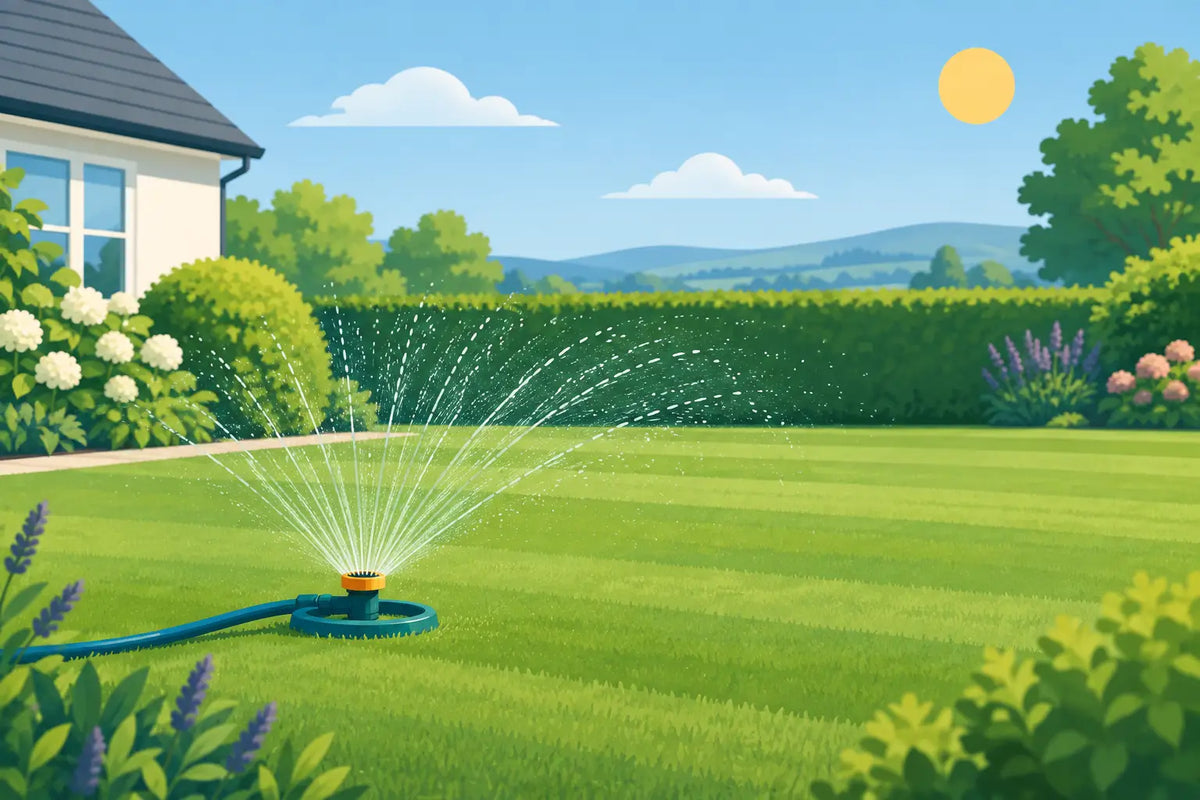
A lawn can look tired after a few warm, dry days, but reaching for the hose every evening is not always the answer. When should lawns be watered? Usually, early in the morning and only when the grass and soil genuinely need it. The aim is to wet the root zone thoroughly, not keep the surface permanently damp.
For an established UK lawn, occasional dry weather is rarely a crisis. Grass naturally slows down and may turn brown during prolonged drought, then recover when rain returns. Watering is most worthwhile for newly laid turf, newly sown grass, and lawns under stress where you need to retain colour and active growth.
When should lawns be watered for best results?
Water early in the morning, ideally before 9am. Temperatures are lower, evaporation is reduced, and the grass has time to dry as the day warms up. More of the water reaches the soil rather than disappearing into the air.
Evening watering is the second-best option when mornings are not practical. However, avoid watering late at night. Grass that stays wet for hours in cool, still conditions is more susceptible to fungal problems, including red thread and leaf spot. If you must water in the evening, do it early enough for the blades to dry before nightfall.
Avoid watering in the middle of a hot afternoon. It is not harmful because sunlight is on the lawn, but it is inefficient. High temperatures and breezes increase evaporation, so you may use far more water than the lawn receives.
Check whether the lawn actually needs water
Do not rely on colour alone. A lawn can look slightly dull in dry weather yet still have enough moisture below the surface. Walk across the grass and look behind you. If your footprints remain visible because the blades do not spring back, the lawn may be short of water.
You can also push a screwdriver, trowel or soil probe into the ground. If it is difficult to push beyond a few centimetres, the soil is dry and compacted. A small hole will show whether moisture is still present around the roots.
Established grass is tougher than many gardeners expect. In a typical British summer, rainfall often provides enough water. During a hosepipe restriction, allow a mature lawn to go dormant rather than using prohibited water supplies. It may become brown, but healthy turf generally recovers once wetter weather returns. Newly laid turf is different: it has shallow roots and needs consistent moisture while it establishes.
How often should a lawn be watered?
The right frequency depends on weather, soil and the age of the lawn. As a practical rule, an established lawn in a sustained dry spell normally benefits more from one deep watering each week than light watering every day. Aim to wet the soil to a depth of around 10 to 15cm.
Many lawns need roughly 20 to 25mm of water during a dry week, including any rainfall. That is a useful starting point, not a fixed rule. Sandy soil drains quickly and may need watering more often. Clay soil holds water for longer, but it is easy to apply water too quickly and create runoff. Shaded lawns and areas with deeper soil often need less than exposed, free-draining ground.
Daily light watering creates shallow roots. The lawn then becomes increasingly dependent on regular watering and struggles when conditions turn dry. A deep soak encourages roots to follow moisture further into the soil, helping the grass cope better between watering sessions.
New turf and newly seeded areas need a different approach. Keep the surface evenly moist until roots establish or seedlings are well anchored, but do not leave puddles. This can mean lighter watering every day in warm, dry weather, sometimes twice daily for fresh seed. Reduce the frequency gradually as the grass starts rooting into the soil beneath.
Water slowly enough for the soil to absorb it
A lawn does not benefit if water runs along the surface, down the drive or into a drain. Apply water at a controlled rate, especially on slopes, compacted ground and heavy clay. If pooling starts, stop for 20 to 30 minutes, then continue. This soak-and-cycle method gives the soil time to take in the water.
A simple rain gauge or straight-sided container helps measure output. Place it on the lawn while the sprinkler is running. When it contains 20 to 25mm of water, you know how long that particular sprinkler takes to deliver a useful weekly soak. This is more accurate than guessing by the clock, because flow rates vary with water pressure, hose length and sprinkler type.
Before increasing watering, check for compaction and thatch. Compacted ground sheds water rather than absorbing it, while a thick thatch layer can hold moisture above the soil. Aerating compacted areas in suitable conditions and keeping thatch under control can make rainfall and irrigation far more effective.
Choosing a practical lawn-watering set-up
For a small lawn, a hose pipe and adjustable sprinkler may be all that is needed. Choose a sprinkler pattern that matches the area, rather than spraying paths, fences and borders. Oscillating sprinklers suit many rectangular lawns, while rotary or impulse models can cover wider or more irregular spaces.
A larger lawn, or a garden where watering needs to happen before work, is better suited to a planned sprinkler system. Pop-up sprinklers keep the area clear when not in use and can give more even coverage than a manually moved hose. Correct spacing matters: sprinkler patterns should overlap slightly so the outer edges receive enough water.
A water timer is useful for controlling duration and avoiding forgotten watering sessions. Add a rain sensor where appropriate so a scheduled cycle does not run after useful rainfall. Pressure regulators, suitable connectors and correctly sized hose or irrigation tube also matter. A poorly matched system may give strong coverage close to the tap and weak, uneven output at the far end.
Topiary Garden supplies the practical components needed to build, extend or repair a lawn-watering arrangement, from timers and sprinklers to connectors, valves and pressure-control fittings.
Adjust watering around mowing and weather
Do not mow a drought-stressed lawn too short. Raise the mowing height slightly during dry periods so the grass retains more moisture and shades the soil. Never remove more than one-third of the leaf height in a single cut. Leave clippings only if they are short and evenly spread; thick clumps can smother the grass and hold unwanted moisture against it.
After heavy rain, pause automatic watering and check the soil before restarting. The same applies after a cool, cloudy spell. Timers are helpful, but they should support observation rather than replace it. A lawn on sandy soil in full sun may need a different schedule from one only a few metres away beneath partial shade.
Wind also changes the result. Sprinklers can drift significantly in breezy conditions, leaving one side of the lawn dry and soaking nearby beds or windows. Water early, when wind is often lighter, and adjust the sprinkler position or pattern if coverage is uneven.
Common lawn-watering mistakes
The most common mistake is watering little and often. It feels careful, but it wastes water and trains roots to stay near the surface. The next is watering a lawn that is merely dormant, rather than genuinely at risk. Brown summer grass can be a normal survival response, not a sign that the lawn has died.
Another problem is treating every section of the garden alike. Lawns beside walls, under trees, on slopes and over shallow soil dry at different rates. Tree roots compete strongly for moisture, and a sprinkler may not solve the underlying problem. Consider targeted watering, a more shade-tolerant grass mix, or accepting a less uniform finish in difficult areas.
Finally, do not run a sprinkler without checking it. Watch the first few minutes to make sure water is reaching the intended area, connections are secure and no water is being lost at a split hose or loose fitting.
A good lawn-watering routine should be simple: inspect the soil, water deeply when it is dry, and let the weather do the rest. Set the system up to deliver water where roots can use it, then spend less time moving a hose and more time enjoying the garden.