
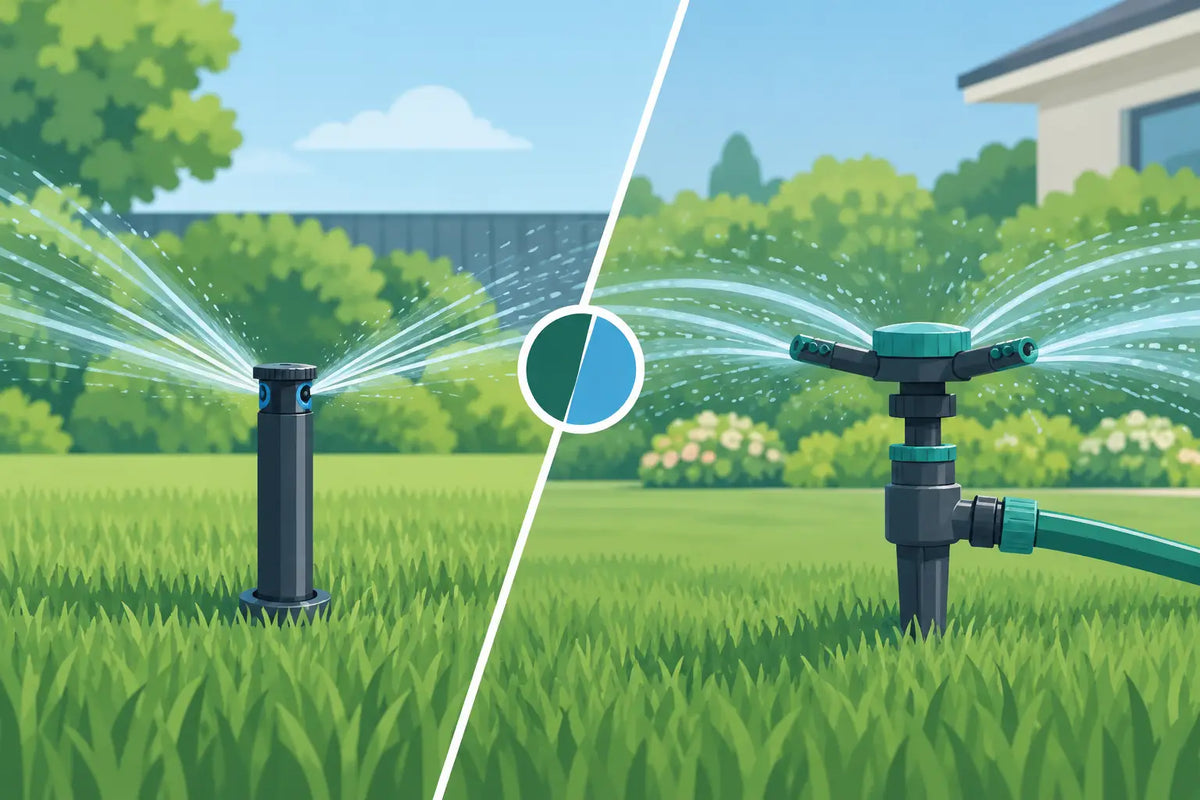
A sprinkler that leaves dry strips across the lawn or soaks the patio is not saving time or water. When comparing pop-up versus rotary sprinklers, the right choice comes down to the area being watered, the available pressure and how precisely you need to control the spray. Both can form part of a dependable automatic watering system, but they do different jobs.
For most UK gardens, fixed-spray pop-up sprinklers suit smaller, shaped lawn sections and planted borders. Rotary sprinklers are generally better for larger open lawns where a slower, longer throw is useful. The detail matters, though: many rotary heads are fitted inside pop-up bodies. The real comparison is usually fixed spray versus rotating stream.
Pop up versus rotary sprinklers: the practical difference
A pop-up sprinkler sits below ground level when the system is off. When water pressure reaches the head, a spring-loaded riser lifts up and sprays across the chosen area. Fixed-spray versions apply water in a fan-shaped pattern at a set arc, such as a quarter, half or full circle. They are commonly used where the watering area is relatively short and predictable.
A rotary sprinkler also rises from the ground in many installations, but it delivers one or more rotating streams rather than a continuous fan of fine spray. These streams travel further and apply water more slowly. Some models rotate continuously, while others move through an adjustable arc.
That slower application rate is the key difference. A fixed spray head may water a small patch quickly, whereas a rotor needs a longer run time to give the same amount of water. It is not a fault. It helps the soil absorb water rather than allowing it to run across compacted ground or down a slope.
Choose fixed-spray pop-ups for small, defined areas
Fixed-spray pop-up sprinklers are a sensible option for narrow lawns, small front gardens and borders with simple outlines. Their nozzles can be selected to cover corners, side strips and semicircular edges, allowing you to match the spray to the lawn rather than wetting paths, fences and neighbouring beds.
They are particularly useful where a lawn is broken into several small sections by paving, a pond or a driveway. A short-radius nozzle can cover the space effectively without needing excessive pressure or a lengthy watering cycle.
The trade-off is that fixed sprays use water at a faster rate. On heavy clay, compacted soil or a banked lawn, watering must be managed carefully. A timer with multiple short start times can be more effective than one long cycle. This gives the water time to soak in between runs and reduces puddling.
Spray heads are also more vulnerable to wind because of their finer droplets. In an exposed garden, a breezy afternoon can carry water well beyond the intended area. Run automatic systems early in the morning, when wind is usually lighter and evaporation is lower.
Where pop-up sprays work well
Use fixed-spray pop-ups where the throw required is short, typically around 1.5 to 5 metres depending on the nozzle and pressure. They are a practical fit for small lawns, formal square beds, lawn edges and areas where accurate arcs matter more than long-distance coverage.
They are less suitable for a large, open lawn. Covering a wide area with numerous spray heads can increase the number of zones, fittings and pipe runs required. It can also make it harder to maintain even watering if head spacing is not planned properly.
Choose rotary sprinklers for larger lawns
Rotary sprinklers suit medium and large lawn areas, especially open rectangles where heads can be positioned around the perimeter. Their streams normally reach further than standard fixed-spray nozzles, often covering several metres more from each position. This can reduce the number of heads needed across a lawn.
Because rotors apply water more slowly, they are often a better choice for loam, clay and gently sloping ground. The water has time to move into the root zone, where grass can use it, rather than collecting on the surface. This is useful during dry spells, when lawns need a proper soak rather than a daily light sprinkling.
Rotary heads also tend to cope better with breezes. A defined stream is less easily blown off course than a fine fan spray, although strong winds will still affect any overhead sprinkler. Their longer operating time should be built into your timer schedule from the start.
Where rotary heads need care
A rotor is not automatically the best answer for every large space. It needs sufficient flow and pressure to throw water evenly. If the supply is weak, the head may fail to rotate properly or leave a dry ring near the edge of its coverage.
Rotors also need room. A large-radius stream used on a small lawn will overspray hard surfaces and borders. While adjustable arcs and radius screws give useful control, they cannot turn a long-throw head into a precise narrow-strip sprinkler.
For oddly shaped lawns, it may be better to split the area into zones and use a combination of suitable nozzles. The goal is even coverage, not simply the fewest heads possible.
Do not mix spray and rotary heads on one zone
This is one of the most common design mistakes. Fixed-spray pop-ups and rotary sprinklers usually apply water at very different rates. If they run together for the same length of time, one part of the garden is likely to be underwatered while another is overwatered.
Keep each type on its own valve-controlled zone. Your timer can then run fixed sprays for a shorter period and rotors for longer, based on the soil, weather and season. A rain sensor is worthwhile on an automated system, preventing scheduled watering after useful rainfall.
The same principle applies to lawns and planted beds. A lawn sprinkler can be effective across turf, but it is rarely the most efficient way to water shrubs, vegetables, pots or greenhouse plants. Drip irrigation, drippers and micro sprinklers place water nearer the roots and avoid soaking foliage.
Plan pressure, flow and spacing before buying
Good sprinkler performance begins with the water supply. Household tap pressure is not the whole story. What matters is the pressure and flow available while water is actually moving through your hose, pipework, filters, valves and sprinkler heads.
Check the manufacturer's pressure and flow requirements for the chosen nozzle or rotor. If several heads are connected to one zone, add their flow rates together. If the total demand is higher than the supply can deliver, divide the layout into two or more zones. This is far more reliable than trying to make every head work at once.
Correct spacing matters just as much. Sprinklers should normally be arranged so that the spray from one head reaches the next head. This is often called head-to-head coverage. It compensates for weaker watering at the edge of each pattern and helps avoid dry patches between sprinklers.
Use pressure-regulated pop-up bodies or pressure-control products where appropriate. Excess pressure can create misting from spray nozzles, wasting water and reducing reach. Too little pressure gives poor distribution. A filter is also sensible where small nozzle openings could become blocked by grit or debris.
Installation points that prevent problems later
Set pop-up bodies at finished soil level, not proud of the turf. A raised head is easily struck by a mower, while one buried too deeply may be obstructed by soil and grass. Clear soil away from the riser after installation and check that it rises and retracts freely.
Position heads carefully around paths and boundaries. A nozzle should deliver water to the lawn, not continuously onto paving or brickwork. For borders close to a lawn, use an appropriate arc and keep irrigation zones separate where plants have different watering needs.
Before burying pipework, run the system and inspect every connector, elbow, tee and valve. Look for leaks, weak spray patterns and heads that are not level. It is much easier to correct spacing or replace a connector before the turf has settled back.
How to set a sensible watering schedule
There is no fixed number of minutes that suits every garden. Sandy soil drains quickly and may need shorter, more frequent watering. Clay holds moisture longer but absorbs it slowly, so split cycles are often useful. New turf needs more frequent attention than an established lawn, while a mature lawn generally benefits from deeper, less frequent watering in dry conditions.
Start by checking the soil rather than relying only on the calendar. If the ground is dry several centimetres below the surface, water is needed. If it remains damp, delay the next cycle. Adjust the timer after heavy rain, a heatwave or a change in season.
For a lawn system, place a few straight-sided containers around the coverage area and run a test. Compare the amount collected in each container. This quickly shows whether spacing, arc adjustment or pressure needs attention. It also gives a practical measure of how long each zone takes to apply the water your lawn needs.
A well-planned system does not need to be complicated. Choose fixed-spray pop-ups for short, precise coverage and rotary sprinklers for larger areas that benefit from slower application. Then give each zone the pressure, run time and nozzle layout it needs. That approach uses less water than frequent guesswork and gives grass a better chance of staying healthy through a dry UK summer.