
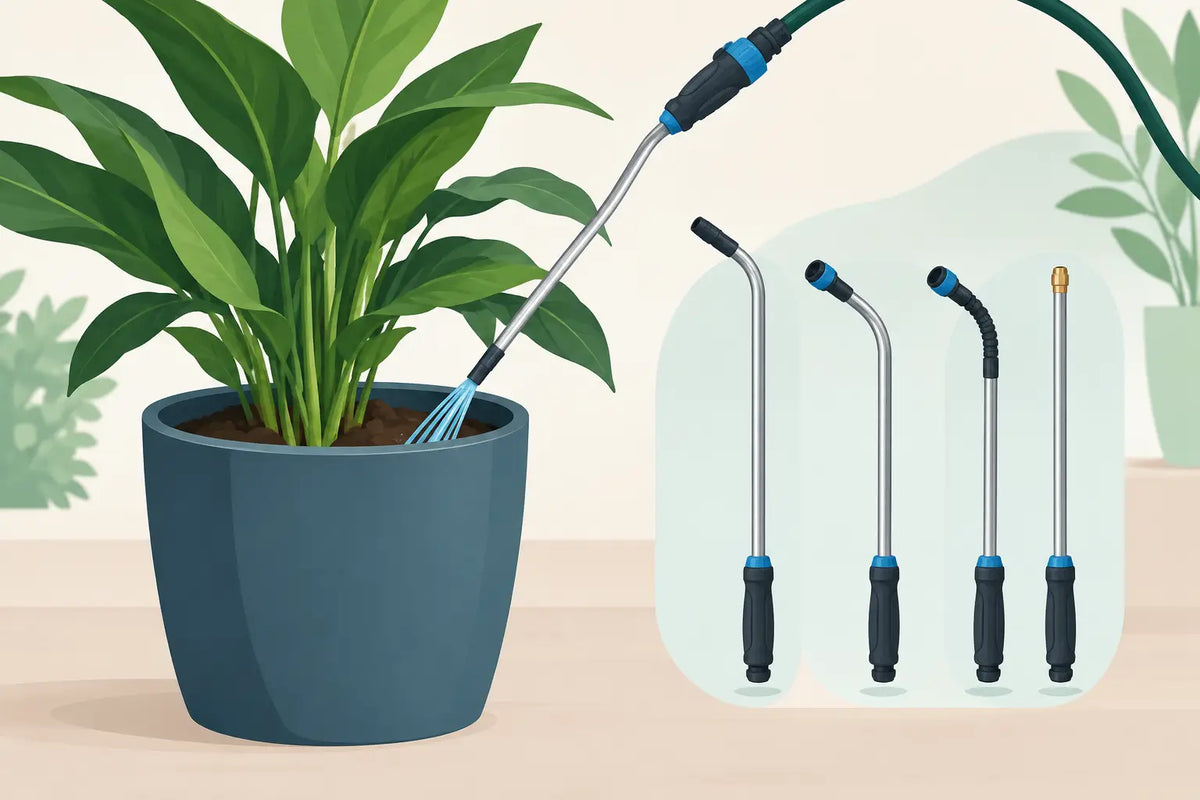
A watering lance for deep pots solves a common container-gardening problem: the compost sits well below the rim, while leaves, flowers and trailing stems make it awkward to reach. Pouring from a can often wets the top edge, splashes the patio and leaves the root zone drier than it should be. A suitable lance lets you direct a controlled spray under the foliage and into the pot, where the water is needed.
Deep pots can be excellent for shrubs, climbers, tomatoes and substantial seasonal planting. They also hold more compost, which means it takes longer for water to travel from the surface to the lower roots. The right watering tool makes regular care quicker and more consistent, especially when several large containers need attention.
Why deep pots need a different watering approach
A shallow terracotta pot can usually be watered from above with a gentle can. A tall planter is less forgiving. When water is applied too quickly, it may run down the inner wall and out through the drainage holes before the compost has absorbed enough. If the compost has dried out completely, it can shrink away from the pot sides and make this channel effect worse.
There is also the practical issue of access. Mature plants can form a dense canopy over the pot opening. Reaching through it with a hose nozzle risks snapping stems, damaging blooms or soaking foliage. Wet leaves are not always a problem, but keeping foliage dry is sensible for plants prone to mildew and other fungal issues.
A lance extends the watering point beyond your hand. Its long tube reaches down through or around foliage, while a rose or spray head spreads water gently across the compost surface. You have a clearer view of where the water is landing, and far less need to lift heavy pots or move plants out of position.
What to look for in a watering lance for deep pots
Length should be your first consideration. A short lance offers better reach than a standard hose spray gun, but may still leave you leaning over large tubs. For tall planters, raised pots and dense planting, a longer model is generally easier to use. It should reach into the container without forcing you to bend stems aside or overreach from an awkward angle.
The head shape matters just as much. A fixed straight head works well for open pots, while an angled or swan-neck design is useful when you need to direct water beneath foliage. The aim is to hold the rose close to the compost, not spray from above. This reduces splashback and helps water soak in rather than bouncing off dry soil.
Choose a fine, gentle rose for most container planting. A soft shower protects loose compost and recently planted specimens, and is less likely to expose roots. A very forceful jet may be useful for cleaning paving, but it is rarely the best setting for watering a deep pot. If your plants include delicate bedding, herbs or young vegetable seedlings, adjustable spray control is particularly useful.
A trigger with variable flow gives better control than a simple on-off fitting. Start with a low flow so the compost has time to absorb water. Increase it only when the surface is accepting moisture readily. A trigger lock can reduce hand strain when watering a long row of containers, although it should not encourage leaving the lance unattended.
Finally, check the fitting. The lance needs to connect securely to your hose system, whether you use a standard quick connector or a branded hose-end arrangement. If you are replacing an older tool, confirm the connector type before ordering. A good seal avoids the irritating drip at the tap end of the job and keeps water going into the pot rather than down your sleeve.
Metal or plastic construction?
Both can be suitable. A metal shaft is often a good choice for regular use, offering rigidity when reaching into tall pots and resilience when stored in a shed or greenhouse. Plastic lances can be lighter and comfortable for everyday patio watering, particularly for gardeners who find heavier hose fittings tiring.
The better option depends on how often it will be used and how it will be stored. Whichever material you choose, avoid dropping the rose head onto paving and drain the tool before frosty weather. Frozen water inside fittings can cause cracks and leaks.
How to water a deep pot properly
Start by placing the rose just above the compost, ideally between the plant stems rather than directly against them. Apply water slowly in one area for a few seconds, then move around the pot to cover the full surface. This is more effective than trying to flood the centre in one go.
For a large container, use a two-pass approach. Give the compost a first light watering, wait a minute or two, then water again more thoroughly. The first pass re-wets a dry surface and reduces run-off; the second has a better chance of reaching the lower root zone.
Watch the drainage holes. A small amount of water emerging underneath shows that moisture has travelled through the compost. Constant, immediate run-off suggests you are applying water too quickly, or that the compost is very dry and needs several slower applications. If water continues to pour out after a modest amount has been applied, check that the pot is not sitting in a saucer or cachepot full of old water.
The weight of the pot is a useful guide. A well-watered large planter feels noticeably heavier than one with dry compost. With experience, you will also recognise the colour and texture of the surface. Do not rely on the top inch alone, though. Deep containers can look dry above while remaining moist lower down, particularly in cool weather.
When a lance is the right tool, and when irrigation is better
A watering lance is ideal where containers need individual attention. It suits mixed displays, newly planted pots, larger feature planters and collections with different watering needs. It is also useful for checking each plant as you water, allowing you to spot pests, wilt, spent flowers or a blocked drainage hole.
For a large number of pots, a drip irrigation set-up may be the more efficient option. Drippers deliver water directly to the compost at a slow rate and can be connected to a timer for dependable holiday watering. This reduces daily work and can use less water than hand watering, particularly in a greenhouse or along a long patio.
The two methods work well together. Use drip irrigation for routine watering, then keep a lance for topping up thirsty plants during hot spells, watering new additions and flushing through a pot where the compost has become unevenly dry. A lance also remains valuable when you want to apply water precisely without altering the rest of the system.
Common mistakes to avoid
Do not use a powerful spray to compensate for a dry pot. It usually creates channels through the compost and sends water out of the base. Slow, repeated applications are more effective.
Avoid watering only around the rim. Roots occupy the whole volume of a deep container, and the centre can become dry even when the outer edge looks damp. Move the rose around the planting, taking care not to blast soil away from the stem bases.
It is also worth avoiding a fixed routine based solely on the calendar. Pots in sun, wind and rain shadow dry at very different rates. A large evergreen shrub may need less frequent watering than a flowering annual in the same-sized container. Check the compost, the plant and the weather before turning on the hose.
Keep the lance working reliably
After use, turn off the tap, release pressure from the hose and drain the lance. This protects seals and makes the tool safer to disconnect. If the spray becomes uneven, remove any visible debris from the rose holes and rinse it through with clean water.
Store the lance where it will not be crushed beneath heavier tools. A straight shaft can bend if it is left under a coiled hose or wedged behind pots. During winter, keep it somewhere protected from frost, especially if the handle or rose contains plastic components.
A well-chosen watering lance turns deep containers from an awkward watering job into a quick, controlled task. Keep the spray low, water steadily and give each pot time to absorb what you apply. Your plants will respond better to that measured approach than to a fast, heavy soaking.