
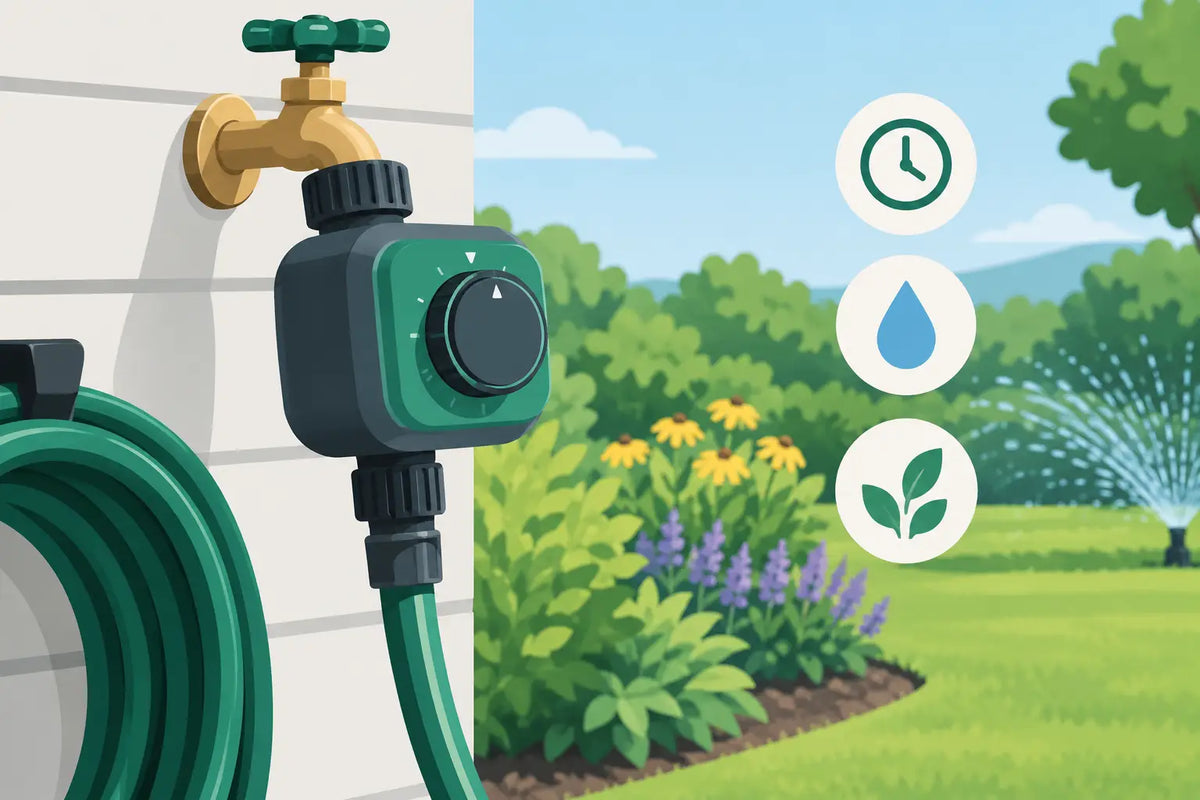
A dry spell can turn pots, hanging baskets and greenhouse crops from healthy to stressed in a matter of days. A water timer for garden hose use gives you control over when watering starts, how long it runs and how often it repeats, without relying on someone being at home to turn the tap on and off.
For many UK gardens, it is the simplest first step towards a more dependable irrigation set-up. Connect a timer to an outdoor tap, attach a hose or irrigation system, programme the schedule and let water reach plants at the right time of day. The result is more consistent moisture around the roots and less water lost to midday evaporation or forgotten watering.
What a garden hose water timer does
A hose timer is a tap-mounted controller. It opens and closes the water supply according to the programme you select. Basic models may provide one watering period per day, while more advanced electronic timers offer multiple starts, flexible run times and separate programmes for different areas.
The timer sits between the tap and your hose connector. From there, it can supply a conventional hose for hand-watering tasks, but it is usually most effective when feeding a fixed system of drip tube, micro irrigation tube, drippers, micro sprinklers or a soaker hose.
This matters because a timer controls time, not water distribution. If a border has uneven coverage, a timer will repeat that uneven coverage precisely. Set up the pipework, drippers and pressure control correctly first, then use the timer to automate a schedule that suits the plants.
Choosing the right water timer for garden hose watering
Start with the number of watering zones you need. A single-outlet timer is suitable where one hose or irrigation line serves the whole area. It works well for a small greenhouse, a run of patio pots, a compact vegetable bed or a simple drip irrigation kit.
A two-outlet timer is useful where different areas need different schedules. For example, a greenhouse may need regular short watering while established border shrubs need a less frequent, deeper soak. Two outlets allow those needs to be managed separately from one tap, provided the available water flow is sufficient for the system.
Battery-powered digital timers give the greatest control. They can usually be programmed for selected days, several start times and precise run lengths. This is practical for thirsty containers in summer, where two short watering cycles can be more effective than one long run that drains straight through the compost.
Mechanical timers are straightforward and can be a sensible option for simple tasks, particularly when you want water to run for a set period. However, they tend to offer less flexibility and are not always suitable for a repeating daily programme. Check the operating functions rather than assuming every timer will meet the same requirement.
Match the timer to the connection
Most garden timers are designed for standard outdoor taps and hose fittings, but compatibility should always be checked before ordering. Consider the tap thread, the inlet and outlet connector type, and whether your hose or irrigation kit uses a standard click fitting.
If you are connecting a timer to drip irrigation, include the correct fittings for the route ahead: hose connector, filter where required, pressure reducer, main supply tube and the relevant take-off connectors. A component-level approach makes future changes much easier. You can extend a line, add pots or replace a worn connector without rebuilding the system.
Pressure, flow and irrigation components
Mains tap pressure can be too high for some micro irrigation systems. Drippers and micro sprinklers are designed to operate within a stated pressure range, and excessive pressure can cause fittings to pop off, uneven output or misting from sprinklers.
A pressure reducer fitted after the timer helps protect the irrigation line and creates more predictable delivery. For a drip system, combine it with a filter to prevent debris reaching narrow dripper passages. This is especially worthwhile if the system will run unattended during a holiday.
Flow rate also affects what one timer can manage. A long line with many drippers, sprinklers or open hose outlets demands more water than a short run feeding a few pots. If the far end of the system receives noticeably less water, do not simply increase the timer run time. Review pipe diameter, line length, pressure regulation and the number of emitters first.
For larger gardens, split the layout into zones. One zone may serve beds and borders, another greenhouse benches, and another hanging baskets. Each can then run for the appropriate duration rather than forcing every plant to receive the same amount.
Set a schedule around your plants, not the clock
Early morning is generally the best time for automatic watering. The garden is cooler, less water evaporates and foliage has time to dry as the day progresses. Evening watering can be useful when necessary, but regularly leaving foliage wet overnight may encourage fungal problems in susceptible plants.
There is no universal programme that suits every garden. Newly planted bedding, vegetable seedlings and containers dry out quickly and often need more frequent checks. Established shrubs and deep-rooted perennials usually benefit more from a thorough, less frequent watering that encourages roots to travel down into the soil.
For pots, check moisture below the compost surface before setting a long cycle. A timer cannot judge recent rainfall, shade, wind or how quickly a particular container dries out. In hot, windy weather, hanging baskets may need a separate line and a different programme from sheltered pots on the patio.
If your timer supports several start times, use that feature carefully. Multiple short cycles can help water soak into dry compost or hard ground, but too many shallow sessions can leave roots near the surface. The aim is even root-zone moisture, not simply wet soil at the top.
Installation checks that prevent common problems
Install the timer upright where possible, with the battery compartment protected from direct spray. Use fresh batteries at the start of the season and keep a spare set ready. A weak battery can stop a programme running when you are away.
Before relying on the system, run it while you are present. Check every connection for drips, make sure the timer opens and closes as programmed, and walk the whole irrigation line. Look for kinked tube, blocked drippers, loose stakes and areas where water is missing the intended root zone.
It is also worth checking after the first few watering cycles. Irrigation tube can settle in warm weather, and a connector that appeared secure at installation may need pushing fully home. For greenhouse systems, make sure the water reaches every pot as plants are moved, spaced out or replaced through the growing season.
At the end of the season, remove the timer before frost is expected. Drain the hose and exposed irrigation lines where practical, then store the timer indoors in a dry place. Freezing water can damage valves, connectors and timer housings.
When a timer is not the whole answer
A water timer is excellent for repeatable routine watering, but it does not replace observation. Heavy rain, a cooler week or a sudden heatwave can all change what plants need. Check plants regularly and adjust the programme instead of leaving a summer setting in place for months.
For gardeners using a water butt, a standard tap timer may not operate reliably with gravity-fed pressure alone. In that situation, a solar irrigation system with its own pump can be the better option. Likewise, if mains water use is a concern, a rain sensor can pause scheduled watering when conditions make it unnecessary.
Topiary Garden stocks timers, pressure-control products, connectors, tubes and emitters for building a system around the space you actually have. Start with one reliable watering zone, test it properly, then add components as your beds, pots or growing area expand.
The best schedule is the one that leaves plants evenly watered without wasting a drop, and a properly chosen timer makes that routine far easier to maintain.