
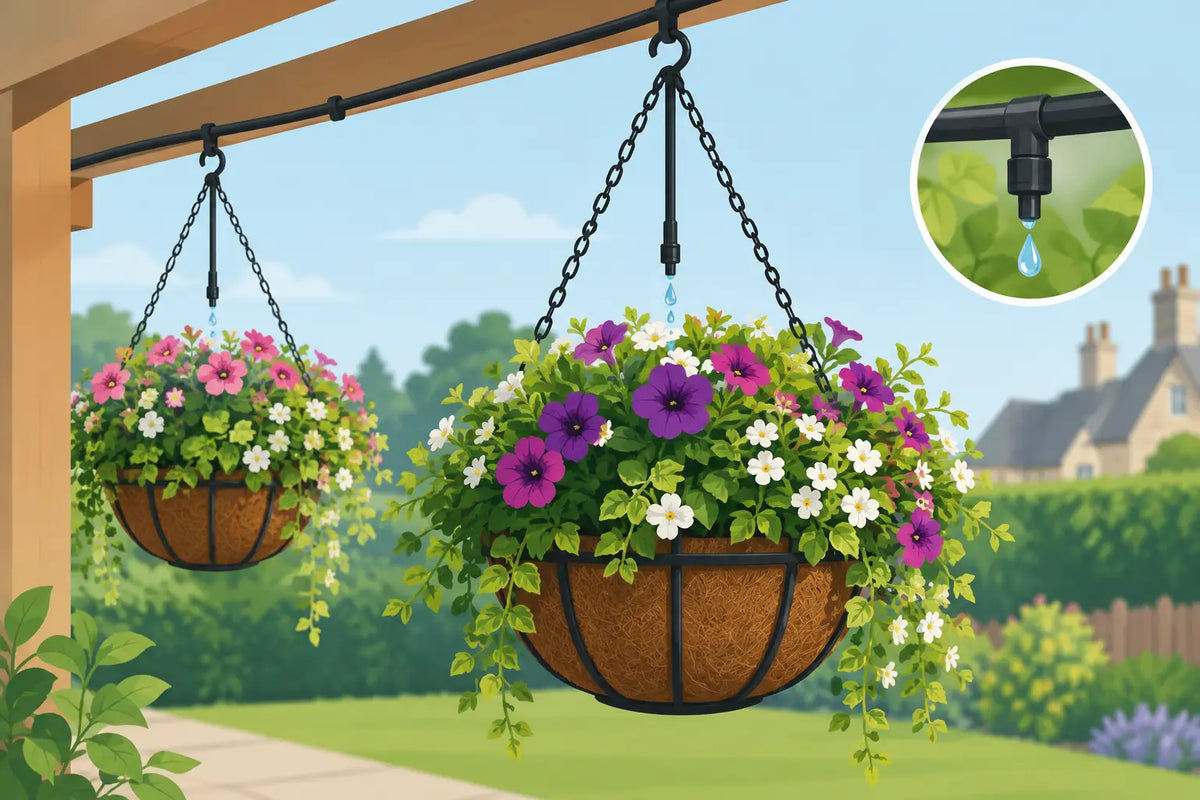
A hanging basket can look well watered from above while its compost is dry around the roots. Wind, sun and the exposed sides of the basket make this one of the fastest-drying planting positions in the garden. The best drippers for hanging baskets supply water slowly at the compost surface, giving it time to soak in rather than run straight through the liner and onto the patio.
For most UK gardens, a small drip irrigation system with one controlled outlet per basket is the most dependable approach. It reduces the daily job of watering, uses less water than a hand-held spray and keeps plants more consistent when you are away for a weekend or holiday. The right dripper is not simply the one with the highest flow rate. It must suit the number of baskets, the length of the pipe run, the water pressure and how quickly each basket dries.
Best drippers for hanging baskets: the practical choice
A fixed-flow end-of-line dripper is usually the best starting point for individual hanging baskets. Each dripper is fitted at the end of a short length of micro tube and positioned in the compost near the plant roots. Because every basket has its own outlet, it is straightforward to add, remove or reposition a basket without altering the rest of the system.
For a typical 25-35 cm hanging basket, choose a low-flow dripper and run the system for a measured period. A 2 litre-per-hour dripper, for example, delivers roughly 330 ml in ten minutes. That may be enough for a small basket on a mild day, but it will not necessarily be enough for a large, heavily planted basket in warm, windy weather. Start with a short cycle, inspect the compost after watering and adjust the timer gradually.
Fixed-flow drippers are a sensible choice where baskets are similar in size and receive similar conditions. They give predictable output and make it easier to calculate watering times. If one basket is sheltered by a wall while another is exposed to afternoon sun, use separate zones where possible or select an adjustable outlet for the thirstier basket.
Which type of dripper suits your set-up?
Fixed-flow button or end-line drippers
These are the straightforward option for most basket irrigation systems. They are compact, predictable and easy to place using a stake or a short section of micro tube. A low-flow model is generally more useful than a high-flow dripper because hanging-basket compost needs a slow soak, not a sudden flood.
Use one dripper for a small basket. Larger baskets, or baskets packed with trailing petunias, calibrachoa, fuchsia or edible plants, may need two outlets positioned on opposite sides. Two lower-flow drippers often wet the root area more evenly than one high-flow outlet in the centre.
Adjustable drippers
Adjustable drippers are useful when basket sizes and planting density vary. You can reduce the flow to a small shaded basket and increase it for a large basket in full sun. They are particularly handy on an existing system where a few plants dry out faster than the rest.
The trade-off is maintenance. An adjustable dripper can be knocked out of position when deadheading or feeding, and settings need checking occasionally. If you prefer a fit-and-forget arrangement, fixed-flow drippers are normally the better choice.
Multi-outlet drippers
A multi-outlet dripper feeds several short micro tubes from one central point. This can be a tidy answer for a group of baskets hanging close together, such as along a fence or outside a greenhouse. Each outlet tube can be taken to a separate basket, saving space on the main supply line.
This arrangement works best when the baskets are at a similar height and need broadly similar amounts of water. Keep outlet tubes as close to equal length as practical. A very long tube or a steep rise can affect how evenly water is shared between outlets, especially on a low-pressure system.
Pressure-compensating drippers
Pressure-compensating drippers are worth considering on longer runs, where baskets are spread around the garden, or where the water source has variable pressure. They are designed to provide a more even flow across the line than standard outlets. This can prevent the first basket receiving too much water while the last receives too little.
They are not essential for a short run of three or four baskets from a small reservoir or tap-fed kit. On a larger mains-fed installation, however, they can make watering more consistent and reduce the need for repeated adjustments.
Build the system around the dripper
A good dripper will not perform properly if the rest of the system is poorly matched. Start with the main irrigation tube appropriate for your chosen fittings, then use take-off connectors to feed micro tube to each basket. A support stake keeps the outlet above the compost and prevents it being buried as plants grow.
If your system connects to a mains tap, use the correct pressure-control component for the irrigation range. High tap pressure can cause fittings to loosen, create uneven flow and make small drippers perform unpredictably. A filter is also worthwhile, particularly if the system draws from a water butt or if the supply water carries sediment. Fine particles are a common cause of blocked outlets.
Place the dripper slightly away from the basket edge. Water delivered directly beside the liner may escape before it has wetted the root zone. In a larger basket, position two outlets either side of the main planting area. Avoid placing a dripper directly against a plant stem, where frequent moisture can encourage problems at the base of the plant.
Set watering times by checking the compost
There is no reliable single timer setting for every hanging basket. Compost volume, liner type, plant size, weather and exposure all change the answer. A basket beneath an eave may receive little rain, while a basket in an open position can dry rapidly after a warm breeze.
Run the system, then check the compost 10-15 minutes later. It should feel evenly damp a few centimetres below the surface, not saturated and not dry beneath a wet top layer. Check again later in the day during warm weather. If the basket is drying too quickly, increase the run time or add a second outlet rather than turning one dripper up excessively.
In summer, early morning watering is usually the most efficient schedule. Plants can take up water before the hottest part of the day, and less moisture is lost to evaporation. During a heatwave, a second short cycle may be needed, particularly for south-facing baskets. Do not rely on rainfall alone: dense foliage and basket liners often prevent enough rain reaching the compost.
Common problems with hanging-basket drippers
If water is dripping from the base almost immediately, the compost may have dried out so much that it is shedding water, or the flow rate may be too high. Water in shorter pulses for a few days to re-wet the compost gradually. A basket with old, compacted compost may also need refreshing rather than more irrigation.
If one basket stays dry, first check for a kinked micro tube, a blocked outlet or a loose connector. Remove the dripper and flush the line briefly before replacing it. If the fault is only at the far end of a long run, review pressure control and consider pressure-compensating drippers.
If baskets are too wet, shorten the programme before changing components. Constantly saturated compost is as damaging as drought and can lead to weak growth, yellowing leaves and root problems. Good drainage holes and a free-draining liner remain essential even with carefully controlled irrigation.
A sensible specification for most gardens
For a row of hanging baskets close to a tap, use a compatible main tube, take-off connectors, short micro-tube branches, low-flow end-line drippers and stakes. Add a timer for repeatable daily watering, plus a suitable filter and pressure control where required by the system. This set-up is easy to extend when you add more pots or baskets next season.
Topiary Garden stocks the component-level parts needed to build a system around your actual layout, rather than forcing every basket into the same watering pattern. Check tube and connector sizes before ordering, especially when extending an existing irrigation line.
A dripper should make hanging baskets easier to maintain, not turn them into another system to constantly manage. Start with a measured low flow, inspect the compost for a week, then let the timer handle the regular work while you keep an eye on the plants themselves.