
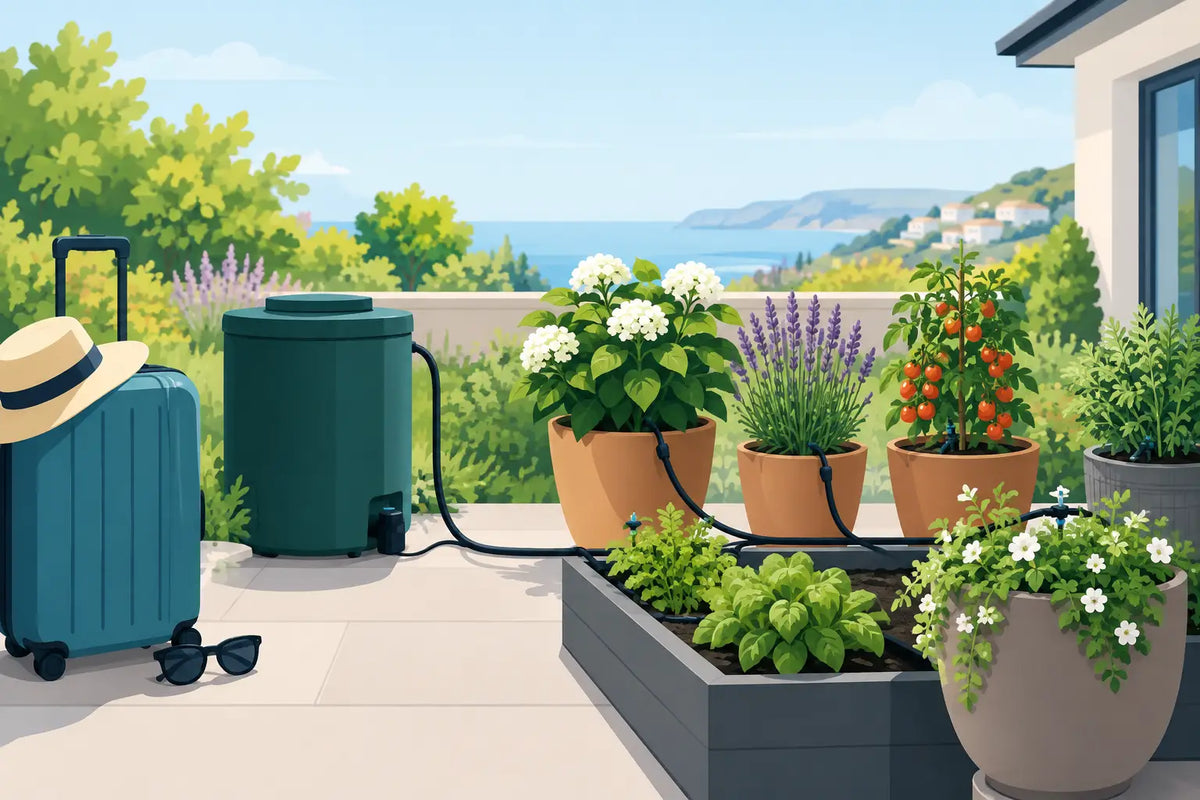
A week away can be enough to damage a container garden in warm, dry weather. Hanging baskets, tomatoes in grow bags and small pots may need water every day, while a well-established border can often manage for longer. A holiday watering setup removes the guesswork by delivering measured water where plants need it, even when nobody is at home to hold the hose.
The most reliable approach is not to water every part of the garden in the same way. Group plants by their needs, use the right irrigation components for each area, and test the system before you leave. That gives you a practical arrangement that saves water rather than simply soaking the garden.
Plan your holiday watering setup by plant type
Start with the plants most likely to dry out. Pots, troughs, hanging baskets, greenhouse crops and newly planted shrubs should be at the top of the list. Their roots have limited compost or soil around them, so they heat up and dry out faster than plants growing in established beds.
Pots and hanging baskets are well suited to drip irrigation. A small supply tube can be run from the main tube to each container, with an adjustable dripper or dripper stake placed at the base of the plant. This puts water into the compost instead of spraying paths, walls or foliage. Larger pots may need two drippers, especially if they contain a thirsty climber or a dense display of bedding plants.
Greenhouse watering needs similar care, but timing matters more. Tomatoes, cucumbers, chillies and peppers prefer regular moisture at the root zone. A timer-controlled drip system can supply short, consistent watering cycles without wetting leaves or making the greenhouse overly humid. Check every pot has drainage before relying on automation. An irrigation system cannot compensate for a container that is already sitting in water.
Established borders, hedges and mature shrubs may need less frequent watering, depending on soil type and recent rainfall. A porous or dripline-style arrangement can work well along a planted row, while micro sprinklers can cover a wider bed where individual drippers would be impractical. Avoid using a sprinkler to water one or two pots. The water loss and uneven coverage are rarely worthwhile.
Lawns are different again. A lawn may look tired after a hot week, but established grass usually recovers when rain returns. If water is limited, prioritise plants that will not recover so easily: vegetables, young plants, pots and hanging baskets.
Build the system from the tap onwards
A dependable setup begins at the water source. For a mains-fed system, fit a suitable tap connector, then add a water timer before the main supply tube. The timer controls when watering starts and stops, giving plants a repeatable schedule rather than relying on a neighbour remembering each visit.
From there, the main tube carries water around the garden or greenhouse. Use connectors to branch into separate areas and fit an isolating valve where you may want independent control. For example, greenhouse tomatoes may need daily watering while a border line only runs every few days. Separate zones make this possible without rebuilding the system.
Pressure is one of the details that can decide whether a system works properly. Many drip and micro-irrigation components perform best with regulated pressure, particularly where there are multiple drippers, long tube runs or delicate micro sprinklers. A pressure reducer helps protect fittings and gives more even flow across the line. Without one, drippers nearest the tap may deliver more water than those at the far end.
Use the correct tube diameter and matching fittings throughout. Mixing incompatible sizes is a common cause of leaks, loose joints and frustrating last-minute repairs. Where a tube crosses a path, secure it or route it safely along the edge so it cannot be crushed by a wheelie bin, mower or foot traffic.
If you are watering from a water butt, check that the system is designed for low-pressure or gravity-fed use. A standard tap-fed kit cannot always produce a useful flow from a butt alone. A solar irrigation system or a purpose-built pump arrangement may be the better option for an allotment, patio or area without an outdoor tap.
Choose emitters that match the job
Drippers are the practical choice for individual pots, grow bags and plants spaced along a border. Adjustable drippers let you fine-tune output, which is useful where a large fuchsia and a small herb pot sit on the same line. Fixed-output drippers suit repeated planting schemes where every container has similar needs.
Dripper stakes make installation tidier in pots and keep the outlet from moving when compost is watered or plants are handled. Position each stake close to the root zone, not against the stem. Water should spread through the compost rather than continuously wet one small point at the surface.
Micro sprinklers are useful for seed trays, densely planted beds and greenhouse benches where broader coverage is needed. They are less efficient in exposed, windy positions, where fine spray can drift away from the intended area. In an open garden, drip irrigation is usually the safer choice for holiday watering because it remains close to the soil.
For a long hedge, vegetable row or narrow border, a run of dripline or regularly spaced drippers can reduce the number of separate connections. Keep the run within the recommended length for the product and flush the line before fitting its end stop. This clears installation debris that could block an emitter later.
Set the timer after testing real water flow
Do not programme a timer based solely on the setting printed on a dripper or sprinkler pack. Water pressure, tube length, height changes and the number of outlets all affect what reaches the plant. Run the system and inspect every zone while it is operating.
A useful test is to place a small container under selected drippers for the same length of time, then compare the amount collected. Check one close to the tap, one at the middle of the line and one at the furthest end. If the difference is substantial, look for a kink, blocked dripper, undersized supply tube or missing pressure control.
In warm summer weather, early morning is normally the most sensible watering time. Less water is lost to evaporation than during the hottest part of the day, and foliage has time to dry. Evening watering can also work for root-zone drip systems, but avoid regular late spraying in a crowded greenhouse where damp leaves can encourage disease.
How often to water depends on the weather, the containers and the plants. A sunny patio of small pots may need a daily run, while larger containers in partial shade may need less. It is better to apply enough water for it to reach the root area than to give a very brief daily sprinkle that only dampens the surface. Check the compost after a test run, several centimetres below the top, before deciding on programme length.
Make the system holiday-proof before you go
Set up the irrigation at least a few days before departure, not on the morning you leave. This gives you time to find small leaks, alter watering durations and replace any weak fitting. It also lets you see how the garden responds through a warm day and an overcast one.
Check the timer battery and confirm that its clock and programme are correct. Make sure the outdoor tap is fully open, the hose or supply tube is not twisted, and every end cap is secure. If your timer has a manual override, use it to confirm water can still pass through after programming.
Mulch makes the watering system more effective. A layer of suitable mulch over border soil or the top of larger containers reduces evaporation and helps keep roots cooler. Move small pots into grouped, sheltered positions where possible, but do not pack them so tightly that air cannot circulate around disease-prone plants.
A rain sensor can be worthwhile for sprinkler-led systems, particularly in changeable UK summer weather. For drip irrigation to pots under eaves, in a greenhouse or beneath dense foliage, rainfall may not reach the compost at all. In those situations, stopping the programme automatically after light rain can leave plants short of water. This is one of the areas where the right choice depends on where the emitters are placed.
For trips longer than a week, ask a neighbour or friend to inspect the garden once if possible. They do not need to hand-water every plant. Their job is to check that the tap is on, the timer is running, no tube has come loose and the most vulnerable plants look healthy. Keep a watering can accessible for any container that needs a one-off top-up.
A holiday watering setup should make time away less risky, not create another job to worry about. Build it around your plants, test it under normal conditions and leave enough capacity for hot weather. When you return, the best sign it has done its job is simple: healthy plants, moist compost and no wasted water.