
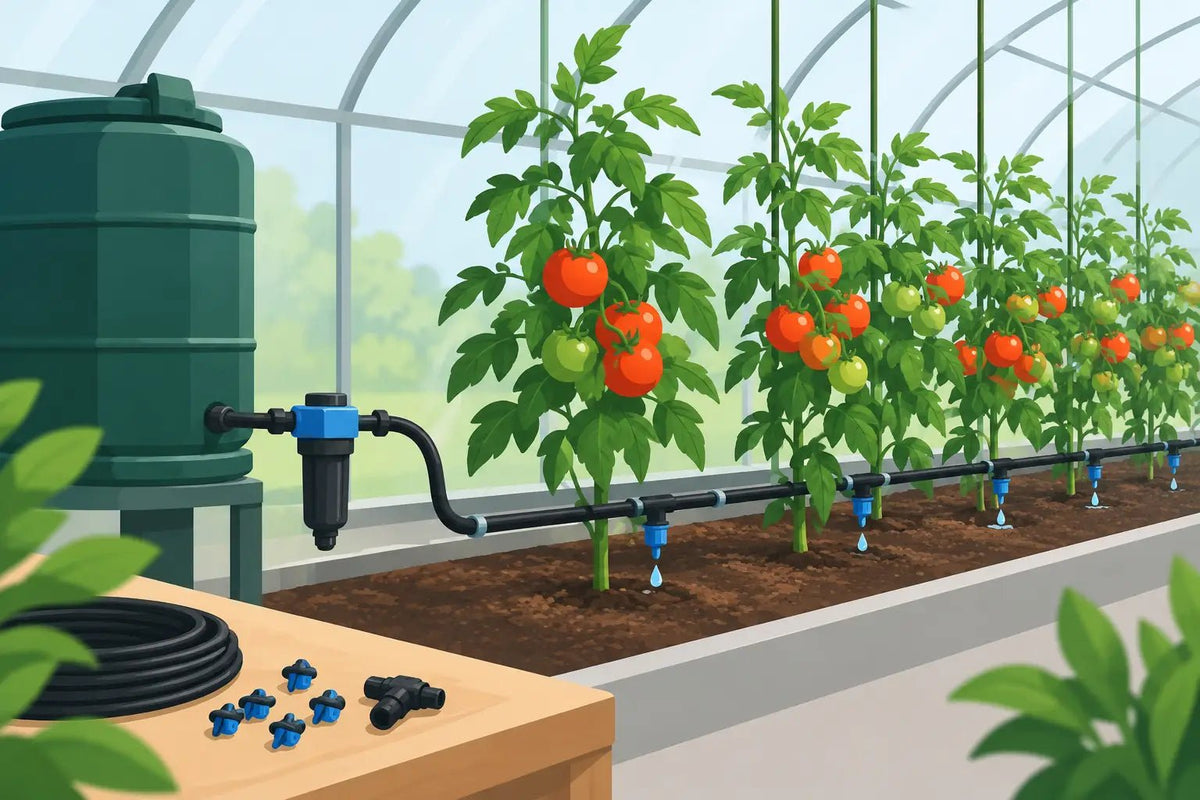
Tomatoes rarely fail in a greenhouse because they need more attention. They fail because their watering swings from too dry to too wet, often within the same week. A greenhouse irrigation kit tomatoes can rely on delivers measured water at the root zone, helping plants stay steady through warm afternoons, busy workdays and time away on holiday.
For most UK greenhouse growers, drip irrigation is the sensible starting point. It uses less water than hand watering, keeps paths and foliage drier, and can be extended as your tomato growing changes from a few pots to a full run of grow bags, pots or border plants. The best system is not necessarily the largest kit. It is the one sized correctly for your layout, water source and number of plants.
Choosing a Greenhouse Irrigation Kit for Tomatoes
Start with where each tomato is growing. A tomato in a 30-litre pot needs its own dripper. A row of plants in a greenhouse border can be supplied by a length of drip line or individual micro tube runs. Grow bags can be watered with one or two outlets per bag, depending on the number of plants and the bag size.
A basic kit should include main supply tube, smaller distribution tube where needed, drippers or drip stakes, connectors, end stops and securing stakes. If it will be connected to a mains tap, add a tap connector and consider a pressure reducer. A timer is strongly worthwhile for anyone who cannot reliably water at the same time every day.
Do not choose purely by the number of outlets printed on the box. A 20-outlet kit may be ideal for 10 tomato plants if each large pot needs two drippers. Equally, a kit designed for many small pots can be unnecessarily complicated for six plants in a greenhouse border. Count the watering points first, then allow a few spare outlets for a cucumber, chilli or replacement plant.
Drippers, drip stakes and drip line
Adjustable drippers are useful when pot sizes vary. They let you increase the flow to a thirsty, established cordon tomato while keeping a young plant or smaller container on a lower setting. They need checking occasionally, as a very open adjustable dripper can deliver more than expected.
Fixed-flow drippers provide greater consistency across matching pots. They suit growers who have similar containers and want a predictable system. Drip stakes are especially tidy for pots and grow bags because they hold the outlet in place beside the stem rather than allowing water to run across the compost surface.
Drip line is often the cleanest choice for a long border. Its built-in emitters distribute water along the run, but emitter spacing must match plant spacing reasonably well. It is less flexible than individual drippers when tomatoes are planted at irregular intervals.
Build the layout before cutting tube
Place the main tube along the greenhouse side or rear, where it will not become a trip hazard. Run it past each pot or planting position, then branch off using smaller micro tube or connectors. Keep the route simple. Every unnecessary join is another point that can be knocked loose while tying in plants, moving pots or sweeping the floor.
Measure the longest route and buy a little more tube than you expect to use. Tube can be cut down easily; a run that is too short usually means an awkward rework. In a warm greenhouse, soften tubing in a bucket of warm water before pushing it onto barbed fittings. This makes installation easier and reduces the temptation to force a connector into place.
Keep the watering outlet a short distance from the main stem. Watering directly against the stem day after day is not useful, particularly in dense compost. Position one dripper on either side of a large pot if possible, so moisture spreads more evenly through the root area.
For a straightforward greenhouse with 8 to 12 tomato pots, run one main supply tube down each side of the house or one central run behind the pots. Fit one or two drippers per pot, cap the end of each run and secure the tube with stakes. This arrangement is easy to inspect and equally easy to expand next season.
Match pressure and flow to the water source
Irrigation components work best at the pressure they were designed for. Mains-fed taps can deliver more pressure than micro-irrigation tube and drippers need, while gravity-fed water butts may not deliver enough for some drippers to perform evenly.
If connecting to a tap, a pressure reducer helps protect the system and produces more consistent output from the first outlet to the last. It is particularly useful where the greenhouse has many drippers or long tube runs. A filter is also sensible if debris could enter from the tap or stored water supply, as blocked outlets are one of the most common causes of dry pots.
A water butt can be a practical choice where mains access is limited, but check that the kit is suitable for low pressure. Some gravity systems use a small pump to maintain reliable flow. Do not assume that any standard tap-fed kit will work well from a butt simply because the fittings connect.
Before planting out, turn the water on and inspect every outlet. Water should reach all plants at a similar rate. Look for drippers that have popped out, crushed tube, loose fittings and puddling around a single pot. Correcting these problems takes minutes before the greenhouse is full and considerably longer once stems are tied to canes.
Use a timer to prevent watering extremes
A timer removes the biggest weakness in manual tomato watering: inconsistency. Tomatoes prefer a reasonably even supply of moisture. Long dry spells followed by a heavy soak can contribute to split fruit, uneven growth and blossom end rot, although nutrition, root restriction and temperature also play a part.
The right schedule depends on pot volume, compost, greenhouse temperature, plant size and weather. There is no useful universal setting. A small plant in spring may need a brief daily watering or less, while a fruiting plant in a warm greenhouse in July may need more than one cycle a day.
Begin with a conservative programme, then check the compost beneath the surface. If it is wet and heavy several centimetres down, reduce the run time. If it is dry below the top layer before the next cycle, increase the duration or frequency. Check at the furthest pot, not only the first one in the line.
Timers should support observation, not replace it. On very hot days, check plants early enough to adjust the programme before leaves wilt. On dull, cool days, avoid watering to a fixed summer routine simply because the timer is set that way.
Feed tomatoes without blocking the system
Tomatoes in containers usually need regular feeding once the first truss has set, but avoid pouring concentrated feed into an irrigation line unless the equipment is intended for fertigation. Thick liquids, particles and poorly dissolved feed can block drippers and create uneven feeding.
For most home greenhouses, it is simpler to run the irrigation system with clean water and feed separately by watering can at the recommended dilution. This also gives you a regular opportunity to inspect plant health, check for pests and make sure each dripper remains positioned correctly.
If you do use a compatible dosing set-up, flush the lines with clean water afterwards. Never leave feed sitting in tube between watering cycles.
Common problems that are easy to avoid
Uneven watering usually comes down to four causes: too many outlets on an undersized supply, no pressure control, a blocked dripper or a kinked tube. Work through these before replacing the whole system. Spare drippers, connectors and end stops are worth keeping in the shed because small parts are easy to damage or misplace.
Algae and dirt are more likely where clear tubing sits in sunlight or water comes from a butt. Keep tube shaded where practical, use filtration where appropriate and flush the line periodically by removing the end stop and running water through it. At the end of the season, drain the system, clean reusable parts and store timers indoors away from frost.
Also avoid placing every dripper at the edge of a pot. Water may run down the side and escape through drainage holes before it reaches the centre of the root ball. Move outlets as the plant grows and roots fill the container.
A well-planned system makes greenhouse tomatoes easier to manage, not automatic in every respect. Set it up before the hot weather arrives, test every outlet, and make small seasonal adjustments. That is how a simple kit keeps plants supplied without wasting water or turning daily watering into a race against the clock.