A hose that shrinks back into a small bundle sounds ideal when the shed is already full of pots, tools and compost. An expandable garden hose can make everyday watering easier, especially on patios, in small gardens, and in greenhouse areas where a conventional hose is awkward to store. However, it is not automatically the best choice for every watering job.
The key is to match the hose to your tap pressure, fittings, and equipment. For light, regular watering, it can be a genuinely useful space-saving option. For long runs, high-demand sprinklers, or a permanent garden watering system, a conventional hosepipe and dedicated irrigation components will usually give more dependable results.

What an expandable garden hose does well
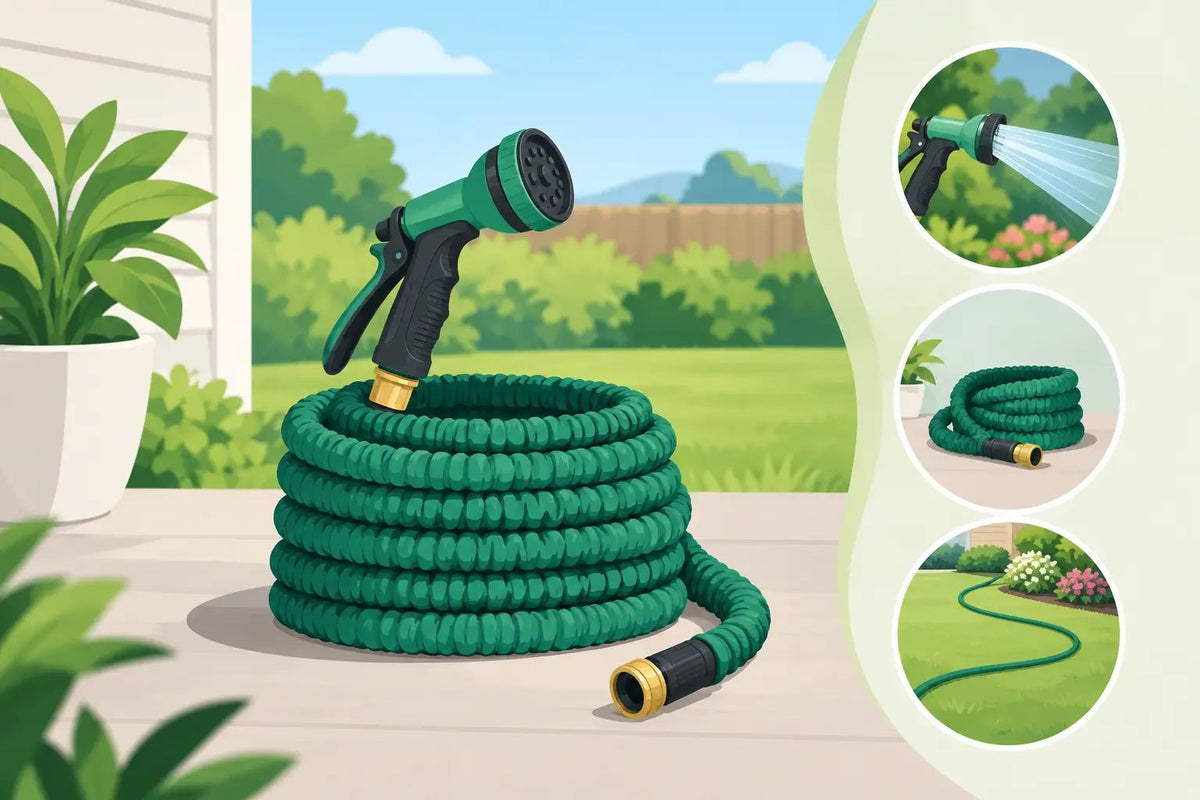
An expandable garden hose has an elastic inner tube inside a protective outer fabric layer. When connected to the tap and filled with water, the inner tube expands. Turn off the water, release the pressure through the spray gun, and it contracts again for compact storage.
This makes it particularly practical for watering containers, borders close to the house, hanging baskets and greenhouse benches. It is lightweight to carry, less likely to form the heavy loops associated with traditional hose pipes and can be put away quickly after use. For gardeners with limited storage space, that convenience is the main attraction.
It can also be kinder to delicate planting areas. A lighter hose is easier to lift over a bed than drag across young plants, and a multi-pattern spray gun lets you use a soft shower setting for seedlings or a more direct stream for rinsing pots and paths.
That said, the advertised expanded length is not the same as its length when stored. Many hoses are described as expanding to two or three times their resting size, but the actual reach depends on water pressure. Measure the distance from your tap to the furthest point you need to water, then allow a little extra for going around corners and beds.
Where an expandable garden hose can fall short
The compact design has trade-offs. Because the hose relies on water pressure to expand and remain firm, performance can vary between properties. A low-pressure supply may leave the hose shorter than expected or reduce the flow at the spray gun. This matters most when you are trying to cover a longer garden.
It is also not the first choice for equipment that requires a consistent, higher flow rate. Rotary sprinklers, large lawn sprinklers and some pressure washers are better suited to a quality conventional hose of the appropriate diameter. A standard hose pipe is generally more stable over distance and easier to use with a hose reel, trolley or permanent tap connection.
Expandable hoses are designed for watering, not for being pulled around the garden by their fittings. The outer cover can snag on rough paving, sharp brick edges, rose thorns or gravel. Repeated abrasion can damage the fabric and, eventually, the inner tube. If your route includes a narrow side passage or rough surfaces, a conventional hose on a reel may be the more durable option.
For the same reason, do not leave an expandable hose pressurised and unattended. Turn off the tap after use and operate the spray gun until the hose has emptied. This reduces strain on the hose, connectors and tap fitting, while preventing a surprise puddle if a fitting loosens.
Choosing the right expandable garden hose
Start with the working distance rather than the largest number on the box. A short hose is easier to manage and normally provides stronger flow, provided it reaches the areas you need. Buying far more length than necessary can make the hose slower to fill, harder to control and more prone to tangling.
Check the supplied fittings carefully. Most UK garden taps and accessories use standard quick-connect systems, but not every hose includes connectors of equal quality. Look for secure tap adaptors, a compatible hose-end connector and a spray gun that can be replaced if needed. Metal connectors can feel more substantial, while good-quality plastic fittings are often lighter and resist corrosion. What matters most is a firm, leak-free fit.
The threads on your outdoor tap also matter. Many taps accept a 3/4-inch threaded connector, though adaptors are available for other sizes. If you have an indoor tap, a mixer tap or an older fitting, confirm compatibility before choosing a hose. A small leak at the tap can waste more water than expected over a summer of regular use.
Before buying, consider these practical points:
- Your available water pressure and the expanded reach required.
- Whether you need a soft spray for plants, a jet for cleaning, or both.
- The surfaces the hose must cross and the risk of snags.
- Whether your existing tap connector, sprinkler or lance uses compatible fittings.
A hose may be sold with a spray gun, but that does not mean the supplied gun is right for every job. A watering lance gives better reach into deep borders and hanging baskets, while a trigger gun is convenient for pots, patio containers and quick rinsing. Choose the delivery end around the task, not just the hose itself.
Expandable hose or irrigation system?
An expandable hose is useful when you are present and watering by hand. It gives flexibility: you can give a thirsty pot extra water, avoid soaking a plant that prefers drier soil and spot problems while you work around the garden. It is a sensible tool for occasional jobs and small spaces.
It does not replace a planned irrigation system where watering needs to happen consistently. Drip irrigation tubing, drippers, and micro sprinklers deliver water at or near the root zone, where plants can use it. This reduces evaporation compared with spraying a whole bed and is especially useful for greenhouses, raised beds, productive plots and rows of pots.
A timer adds another level of control. Instead of relying on someone to water during a hot week or while you are away on holiday, it can run the system at a chosen time. Pairing a timer with a pressure reducer, filter, and the correct connectors helps create a more reliable set-up, particularly where several drippers or micro sprinklers run from one tap.
There is room for both approaches. Use drip lines for regular watering of established beds, tomatoes, and greenhouse crops, then keep an expandable hose for hand watering new plants, washing down hard surfaces, and dealing with containers that dry out faster than the rest. This prevents the hose from becoming the only answer to a larger watering problem.
Fittings, pressure and avoiding leaks
Watering equipment performs only as well as its connections. Push-fit connectors should be fully engaged, with the hose cut cleanly and seated straight. If a connector leaks, check the rubber washer first. A flattened, missing or dirty washer is a common cause of drips and is cheaper to replace than the whole fitting.
Avoid forcing incompatible threads together. A connector that seems to fit but cross-threads can damage the tap or fail under pressure. If you are joining to irrigation tubing, use the connector designed for that tube diameter rather than trying to make a hose fitting do two jobs.
Pressure is also worth managing. Expandable hoses need enough pressure to function, while drip irrigation often needs pressure regulation to protect small drippers and maintain even output. These are different requirements. If you intend to run both from one tap, use the appropriate connectors and controls rather than leaving a hose permanently attached to an irrigation line.
Care through the British gardening season
After each use, turn off the water supply, open the spray gun and let the hose contract as it drains. Coil it loosely or place it in a dry, shaded position. Storing it out of direct sunlight helps protect the outer cover, while keeping it off damp ground reduces unnecessary wear.
Before the first hard frost, disconnect and drain the hose completely. Water left inside can freeze, expand and damage the inner tube or fittings. This is good practice for all garden watering equipment, including timers, filters and exposed irrigation lines.
Inspect the hose periodically for fraying, soft spots, loose end fittings and perished washers. A small issue caught early is often a simple connector or washer replacement. If the hose has developed a split inner tube, replacement is normally safer and more economical than attempting a temporary repair.
An expandable garden hose earns its place when storage is tight, and watering is light, frequent and close at hand. Choose one with suitable fittings, treat it as a hand-watering tool rather than a permanent system, and drain it properly after use. For the areas that need regular, measured watering, a simple drip set-up can take the pressure off both your plants and your watering routine.