
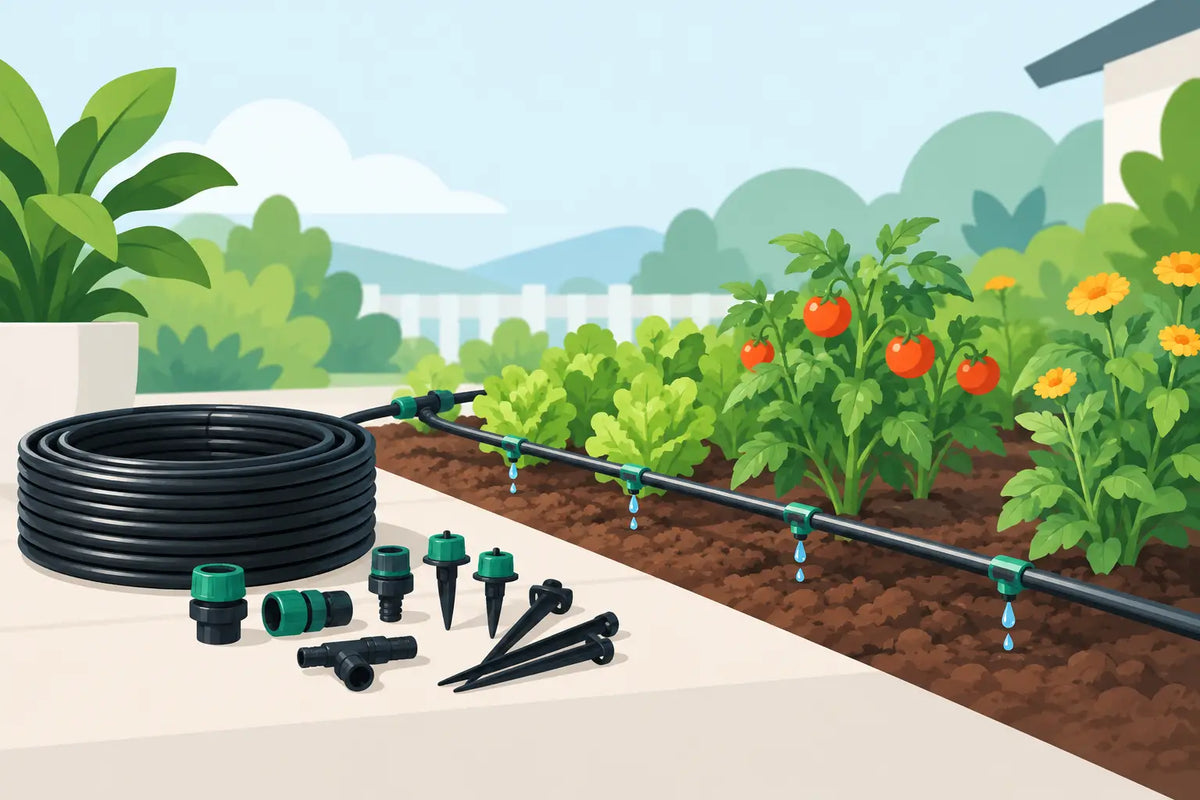
A dry week can turn healthy containers, greenhouse tomatoes and newly planted borders into a daily watering job. Garden irrigation kits replace the guesswork with measured, regular watering at the root zone, helping plants stay in better condition while reducing waste from a hose or watering can.
The right kit is not necessarily the biggest one. A small patio with six pots needs a different set-up from a long vegetable plot, and a gravity-fed water butt needs different components from a mains tap. Start with the area you need to water, then choose a system that can be extended as your garden changes.
What a garden irrigation kit should include
Most garden irrigation kits provide the core parts needed to take water from a tap to plants: supply tube, connectors, take-off fittings, stakes and outlets such as drippers or micro sprinklers. Some kits also include a timer, pressure reducer or filter. These are not extras to overlook. They are often what make a system perform consistently rather than simply deliver water.
The supply tube is the main route around the garden. Smaller micro tube branches off it to individual pots, rows or plants. Connectors allow you to create corners, tees, joins and end stops, while stakes keep tube and drippers where they are meant to be. A system built from standard components is easier to repair, extend and adapt next season.
For tap-fed systems, a pressure reducer is usually worthwhile. Mains pressure can be too high for drip irrigation fittings and emitters, causing leaks, joints that work loose or uneven flow. A filter helps prevent small particles blocking drippers, particularly where water comes from a butt, tank or older outdoor tap.
Match the watering method to the planting area
A kit is only as effective as its outlets. Drippers, adjustable drippers and micro sprinklers all have a place, but they serve different growing conditions.
Drippers for pots, borders and individual plants
Drippers apply water slowly and close to the soil. They are a sound choice for patio pots, hanging baskets, tomato plants, shrubs and established border plants. Water has time to soak down to the roots rather than running across dry compost or compacted soil.
Fixed-flow drippers suit areas where plants have similar needs. Adjustable drippers are more flexible when a large pot sits beside a smaller one, or when thirsty courgettes share a line with herbs. Adjustable units need occasional checking, as a setting can be moved during maintenance or by an accidental knock.
For containers, use one dripper for smaller pots and more for large planters or thirsty crops. The exact number depends on pot size, compost, exposure and plant type. A pot in full sun against a south-facing wall may need significantly more water than the same pot in partial shade.
Micro sprinklers for wider coverage
Micro sprinklers are useful where many plants are grouped together, such as greenhouse benches, vegetable rows, flower beds and low groundcover. They water an area rather than one point, making installation quicker where individual drippers would be impractical.
The trade-off is that sprinklers wet foliage as well as soil. That is usually acceptable for many outdoor beds, but tomatoes and other plants prone to fungal problems are generally better watered at the base. In a greenhouse, good ventilation matters whenever sprinklers are used.
Pop-up sprinklers for lawns
Lawns require a separate approach. Pop-up sprinklers are designed for broader, more even coverage and can sit below ground level when not in use. They need careful positioning and compatible pressure to avoid dry strips, overspray onto paths and water landing on walls or fences.
A lawn system is more involved than a simple pot-watering kit, but it is easier to manage when divided into zones. This allows a larger area to be watered in sections without exceeding the available flow from the tap.
Plan the route before cutting tube
Lay out the main tube on the ground first. Run it along bed edges, behind pots or through the greenhouse where it is protected from foot traffic and easy to inspect. Avoid sharp bends and leave a little extra tube at corners or around movable pots. It is easier to trim excess length than add it back after a cut.
Measure the distance from the tap to the furthest plant and allow for branches. Check the tube diameter used by the kit before ordering extension parts. Irrigation components are not universally interchangeable, and fittings designed for one tube size may not seal correctly on another.
Think about watering zones at the planning stage. A greenhouse, hanging baskets and a shaded border rarely need the same frequency or duration. Separating them with valves or using more than one timer gives better control. It also means you can turn off a section after rain without interrupting watering elsewhere.
Add a timer for dependable routine watering
A water timer is one of the most useful additions to garden irrigation kits, especially during warm spells and holidays. It applies water at the time and duration you set, removing the risk of forgetting a greenhouse watering run on a busy morning.
Early morning is often a practical time to water. Plants can take up moisture before the hottest part of the day, and less water is lost through evaporation than at midday. Evening watering can also work, although repeatedly leaving foliage wet overnight may not suit plants that are susceptible to disease.
Do not assume a timer eliminates all checks. Inspect the system before going away, replace weak batteries, make sure the tap is fully open and confirm that every zone is receiving water. Run a full cycle while you are present. A blocked dripper or disconnected branch is much easier to correct before a holiday than after one.
Rain sensors can prevent unnecessary watering when conditions are wet. They are particularly useful for outdoor beds and lawns. They are less relevant to greenhouses, covered porches and hanging baskets under shelter, where rain may not reach the compost at all.
Use water wisely without starving plants
Efficient watering is not simply about using less water. It means putting the right amount where plants can use it. Drip irrigation reduces water lost to evaporation and keeps paths, leaves and surrounding soil drier than overhead watering. It can also make a water butt supply go further when paired with a suitable low-pressure or solar irrigation arrangement.
A gravity-fed system has limits. Water pressure from a butt depends on its height and water level, so standard pressure-compensating drippers may not perform as intended. Choose components designed for low-pressure use, keep pipe runs sensible and test the flow at the furthest outlet. Raising the butt can improve pressure, but only if it is securely supported.
Mulching beds and containers complements irrigation well. A layer of suitable mulch slows moisture loss from the soil, so watering reaches roots more effectively. It does not remove the need to water, particularly in pots, but it can reduce how quickly soil dries between cycles.
Installation checks that prevent common problems
Before fitting outlets, flush the main tube briefly to remove any debris introduced during cutting. Then fit the end stop and check every connector is pushed fully home. Where the system uses barbed fittings, warming tube slightly in hand-warm water can make assembly easier. Avoid heating it aggressively, as distorted tube may not seal properly.
Once installed, run the system and walk the full route. Look for drips around joins, kinked tube, weak spray patterns and dry emitters. Check that stakes are secure and that drippers remain close to the intended plant. In beds, mulch and plant growth can hide components, so leave enough access for adjustment.
Clean filters regularly, particularly after plumbing work, periods of low water quality or use with stored water. At the end of the season, drain systems that may be exposed to frost. Water left in timers, filters and above-ground tube can freeze and damage components.
Build a system that can grow with the garden
A starter kit is a practical beginning, not a limit. Add extra tube when new pots arrive, fit another branch for a raised bed or replace a damaged connector rather than rebuilding the whole line. Keeping a few matching tees, elbows, end stops and repair joins on hand makes small changes straightforward.
For gardeners who want dependable daily watering, choose a kit around the water source, planting layout and outlet type rather than the number of pieces in the box. A well-planned system delivers water where it matters, stays easy to maintain and gives you one less job to worry about when the weather turns dry.