
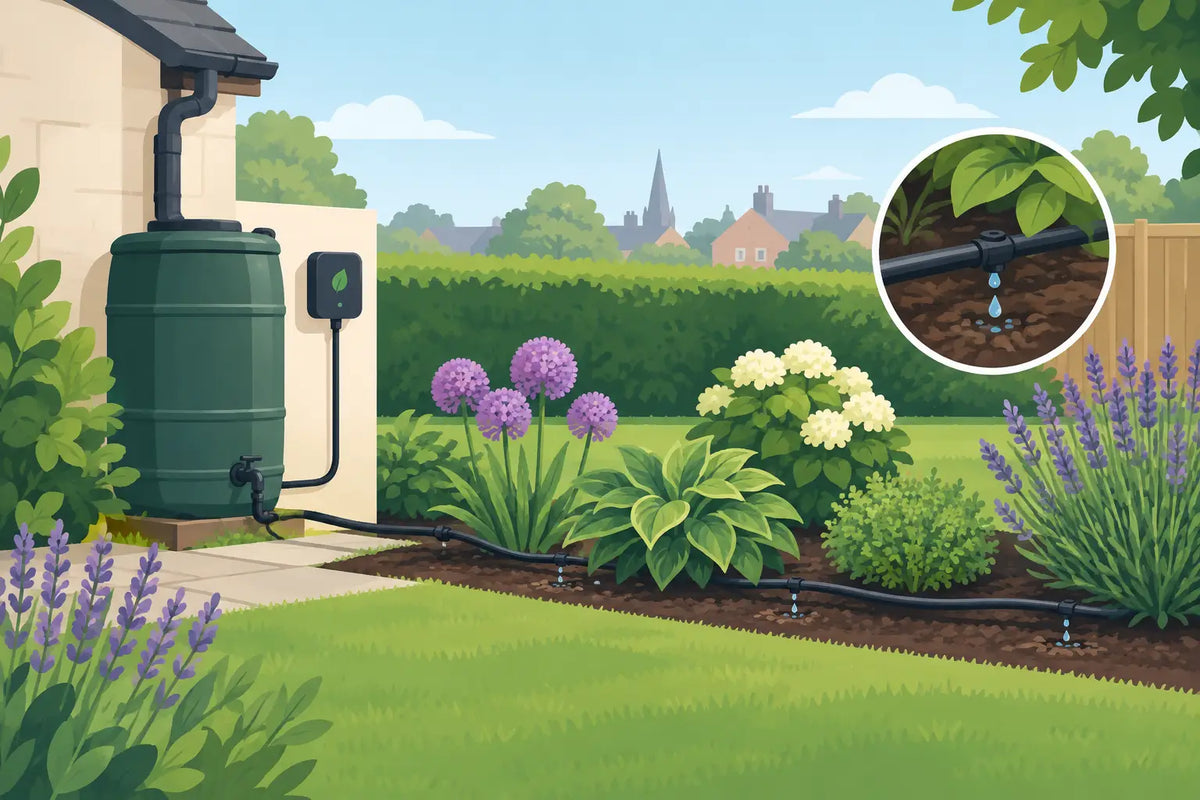
A border can look perfectly watered from the surface while its roots are still dry. Equally, a lawn sprinkler can run for an hour after a useful shower because nobody is home to turn it off. Smart irrigation solves these everyday problems by controlling when, where and how much water reaches each part of the garden.
For most UK gardens, smart does not need to mean complicated. A dependable system may be as straightforward as a battery water timer on an outdoor tap, drip tube around beds and pots, and the right connectors to extend it as the garden changes. Add a rain sensor, moisture-aware controller or separate watering zones where they genuinely earn their place.

What smart irrigation actually means
Smart irrigation is watering that responds to a schedule, conditions or the needs of a particular growing area, rather than relying on a hose and good intentions. The aim is controlled delivery: enough water at the root zone to keep plants healthy, with less evaporation, run-off and waste.
A simple timed system is often the best starting point. It gives containers, greenhouse crops and newly planted shrubs a regular watering cycle, even when you are busy or away on holiday. More advanced controls can pause a programme after rainfall or alter watering according to moisture readings. These are useful tools, but they cannot compensate for poorly chosen emitters, leaking joins or unsuitable water pressure.
The most effective set-ups combine sensible automation with the right irrigation method. Drip irrigation suits beds, hedges, vegetable rows and pots because water is applied slowly near the soil. Micro sprinklers are useful where a wider, gentle spray is needed, such as densely planted borders. Pop-up sprinklers are generally better suited to lawns and larger open areas.
Start with the areas that need reliable watering
Trying to automate every square metre at once can make a first installation more expensive and harder to adjust. Start with the areas where missed watering has the clearest impact: greenhouse tomatoes, hanging baskets, patio pots, raised beds and newly planted borders.
Pots and baskets dry quickly because they hold a limited volume of compost. A dripper or small irrigation stake at each container gives more consistent results than occasional heavy hand watering. In a greenhouse, drip lines reduce the daily routine and direct water into the compost instead of wetting foliage, paths and staging.
Established shrubs and mature borders may need less frequent attention, particularly in heavier soils. They can still benefit from a drip line during prolonged dry spells, but they should not necessarily share the same programme as thirsty pots. This is where zones matter. If one timer outlet or valve controls both, the border can be overwatered while the containers receive only enough to get by.
Match the emitter to the job
Drippers deliver a measured flow at a fixed point. They are a practical choice for individual pots, plants spaced along a bed, tomatoes and peppers. Adjustable drippers offer flexibility, although fixed-flow options can make it easier to balance a larger system.
Drip tube with built-in emitters works well for long, regular runs such as vegetable rows, hedge lines and raised beds. It is neat, easy to secure with stakes and straightforward to extend with couplers, elbows and tees.
Micro sprinklers cover a wider area and can be useful for closely planted groundcover or a greenhouse bench. Their trade-off is greater evaporation in warm or windy conditions. Position them carefully and run them during the cooler part of the day, not when a breeze will carry spray onto paving.
For lawns, pop-up sprinklers provide broad coverage without hoses across the grass. They need more planning than a drip system: correct spacing, matched nozzles and adequate pressure are essential if dry patches and overspray are to be avoided.
A timer is useful, but pressure control is just as important
Many watering problems blamed on a timer are actually caused by pressure or flow. Drippers and micro irrigation fittings are designed to work within a suitable pressure range. If the supply is too high, joints can pop apart, spray patterns become uneven and water can be delivered faster than the soil absorbs it. Too little pressure can leave the end of a long run under-watered.
A pressure reducer helps protect a low-pressure drip system connected to a standard outdoor tap. A filter is also worthwhile where water carries sediment, particularly in systems using fine drippers. These small components are easy to overlook, yet they support even delivery and reduce blockages.
Before buying parts, measure the approximate route from tap to the furthest plant and count the outlets you intend to run. Include every dripper, micro sprinkler and branch line. This gives you a clearer idea of the tube length, connector type and likely flow requirement. It also prevents a common mistake: adding more emitters each season until the original layout no longer performs evenly.
Topiary Garden stocks complete kits for straightforward starting points, as well as the tubes, valves, stakes, reducers and connectors needed to alter a system without replacing it.
Use weather controls where they make a real difference
Rain sensors are a sensible addition to sprinkler systems and regularly watered beds. They stop a programme from running when rainfall has already supplied enough water. In the UK, this can avoid a surprising amount of unnecessary watering during unsettled summer weather.
However, rainfall does not always mean every plant has been watered. A light shower may barely wet compost beneath dense foliage, and pots tucked under an eave can remain dry. A rain sensor should therefore be treated as a pause function, not proof that the whole garden has enough moisture.
Soil moisture sensors can be useful for gardeners who want closer control, but placement matters. Put a sensor where it reflects the root zone of the plants being watered, not in a permanently shaded corner or beside a dripper that keeps one small patch wet. For mixed borders, a timer with seasonal adjustment is often more practical than trying to automate every variation in soil and plant type.
Programme for the soil, not just the calendar
The right watering schedule changes with the weather, the soil and plant growth. Sandy ground drains quickly and often needs shorter, more frequent applications. Clay holds water for longer, so a slower, less frequent soak may be better. Containers usually require the closest attention, especially once plants are actively growing or carrying fruit.
Watering early in the morning gives moisture time to reach the roots before the day warms up. It can also reduce evaporation compared with watering in full afternoon sun. Evening watering is sometimes necessary, but avoid routinely leaving foliage wet overnight where disease is a concern.
Check the soil before increasing a programme. Push a finger a few centimetres below the surface near the plant, rather than judging by dry-looking mulch or crusted compost. If it is damp at root level, more water may not be needed. If it is dry, increase run time gradually and check again, rather than making a large jump that leads to run-off.
Build a system you can maintain
A smart irrigation system should be easy to inspect. Run main tube where you can reach it, use stakes to keep lines in place and leave enough slack around corners to avoid strained fittings. At the end of a season, or before a long period of use, flush the system and check drippers for blockages.
Walk the garden while the system is running. Look for wet patches around joins, drippers that have shifted away from their pots, blocked emitters and sprinklers watering fences or paths. A two-minute check can save far more water than any controller setting.
In colder parts of the UK, protect outdoor equipment before frost. Disconnect timers where appropriate, drain exposed pipework and store battery-powered controls according to the manufacturer’s instructions. Replacing a damaged connector in spring is simple; discovering a split line after plants have gone without water is less convenient.
The best smart irrigation system is not the one with the most settings. It is the one that fits your tap, pressure, garden layout and plants, then keeps working when life gets busy. Begin with the plants that cannot afford to be missed, use components that can be extended later, and let regular checks guide the programme as the season changes.